
Vitamin C in Skincare: Why the Form of Vitamin C Matters
Vitamin C in skincare is one of the most researched antioxidants, but not all forms of Vitamin C behave the same way. Stability, solubility and the type of formulation all influence how Vitamin C performs on the skin. Understanding these differences can help you choose a formula that supports brighter-looking, more even and resilient skin without simply chasing the highest percentage.
Why Vitamin C in Skincare Deserves a Role in Your Routine
Vitamin C helps protect the skin from oxidative stress caused by everyday environmental exposure. It is also valued for supporting collagen synthesis and helping improve the appearance of uneven tone, dullness and visible signs of skin ageing. For these reasons, Vitamin C can be especially valuable as part of a consistent morning skincare routine.
Not All Vitamin C Is the Same
The term “Vitamin C” can refer to several different cosmetic ingredients. Pure L-ascorbic acid is the best-known form, but it can be unstable and requires a carefully controlled formulation, including an acidic pH. Vitamin C derivatives offer another approach: depending on the derivative, they can provide greater stability and allow formulators to create products with different textures, delivery systems and skin tolerability.
Oil-Soluble Vitamin C: Tetrahexyldecyl Ascorbate
Tetrahexyldecyl Ascorbate (THD Ascorbate) is an oil-soluble Vitamin C derivative valued in modern skincare for its stability and compatibility with lipid-based formulations. Unlike water-soluble forms of Vitamin C, it can be incorporated into anhydrous oils and concentrates without requiring the low-pH environment associated with L-ascorbic acid. This makes it particularly interesting for elegant, water-free formulas designed to deliver antioxidant support while remaining comfortable on the skin.
Because THD Ascorbate is lipid-soluble, it has an affinity for the skin’s lipid environment. Research on Vitamin C derivatives continues to evolve, so it is important not to assume that one form is universally “better” than another. The effectiveness of a Vitamin C product depends on the form used, its concentration, the complete formulation, packaging and how consistently the product is used.
Why We Chose THD Ascorbate for BIOYOND TriActive Concentrate
When developing TriActive Concentrate, I wanted Vitamin C to work within the formula rather than simply appear on an ingredient list. I chose Tetrahexyldecyl Ascorbate at 4% because its oil solubility and stability make it particularly well suited to this type of anhydrous concentrate. It allowed me to combine Vitamin C with carefully selected plant oils and squalane in a formula designed to feel nourishing without relying on water or a low-pH system.
But Vitamin C is only one part of the formula. TriActive Concentrate pairs 4% THD Ascorbate with 1% bakuchiol and natural bisabolol — three purposeful actives selected to complement one another. Together, they support antioxidant protection, a brighter and more even-looking complexion, and the appearance of smoother, more resilient skin while bisabolol helps provide a soothing element to the formula.
How to Use Vitamin C in Your Morning Routine
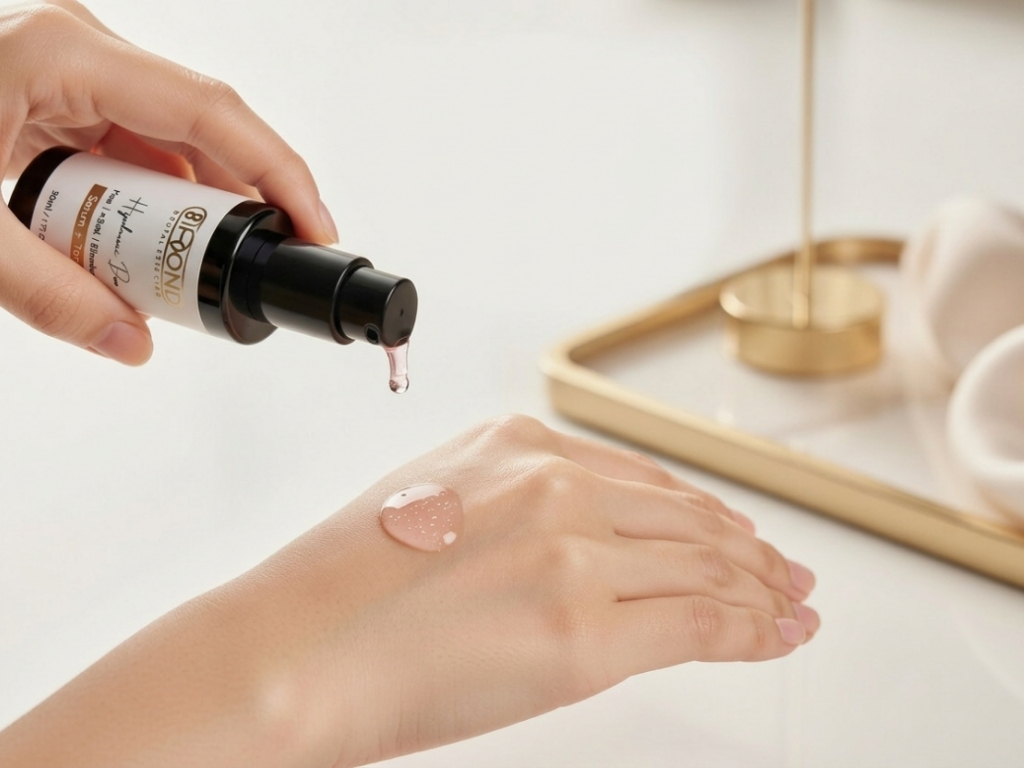
Vitamin C is especially useful in a morning routine because its antioxidant activity complements daily sun protection. After cleansing and applying any water-based toner or serum, apply your Vitamin C product according to its texture. An oil-based concentrate such as TriActive is best used after water-based products and before, or together with, your moisturizer.
A few drops are enough. Gently press the concentrate over the face, neck and décolletage, and finish your morning routine with a broad-spectrum sunscreen. Consistency matters more than applying a large amount — a well-formulated Vitamin C product works best as part of a regular skincare routine.
Can Vitamin C and Bakuchiol Be Used Together?
Yes. Vitamin C derivatives and bakuchiol can be used within the same skincare routine, and they can also be thoughtfully formulated together. Bakuchiol is a plant-derived ingredient valued for helping improve the appearance of fine lines, uneven tone and skin texture, while Vitamin C provides antioxidant support and helps promote a brighter-looking complexion.
In TriActive Concentrate, 1% bakuchiol and 4% THD Ascorbate are combined in the same anhydrous formula, alongside natural bisabolol. This removes the need to layer separate Vitamin C and bakuchiol products and reflects the BIOYOND approach: purposeful ingredients in a streamlined routine rather than adding more products simply for the sake of more.
Choosing a Vitamin C Product: What Matters Most
The highest percentage is not automatically the best Vitamin C product. Look at the form of Vitamin C being used, the overall formulation, packaging and how the product fits into your routine. A formula you can use consistently and comfortably is more valuable than an aggressive product that your skin does not tolerate.
If your skin tends to be dry, sensitive or mature, texture and supporting ingredients can matter just as much as the Vitamin C itself. A well-designed formula should support the skin rather than make you feel that visible irritation is necessary for results.
Vitamin C Skincare FAQs
Which form of Vitamin C is best for skincare?
There is no single form that is best for everyone. L-ascorbic acid has extensive research behind it, while derivatives such as THD Ascorbate offer advantages including improved stability and greater formulation flexibility. The best choice depends on your skin, the complete formula and how you prefer to use Vitamin C.
Can sensitive skin use Vitamin C?
Many people with sensitive skin can use Vitamin C, but tolerance depends on the form, concentration and complete formulation. Introduce a new product gradually and pay attention to how your skin responds rather than assuming that tingling or irritation means a product is working.
Can I use Vitamin C every day?
Vitamin C can be used daily when the formula is appropriate for your skin. Morning use is particularly popular because antioxidant skincare can complement sunscreen as part of a daily routine. Sunscreen remains essential and Vitamin C does not replace it.
A More Thoughtful Approach to Vitamin C
Vitamin C deserves its reputation as an important skincare ingredient, but the form it takes matters. Rather than focusing only on percentages or trends, look for a formulation that considers stability, compatibility and the needs of your skin as a whole.
At BIOYOND, this philosophy led to the creation of TriActive Concentrate with 4% oil-soluble THD Ascorbate, 1% bakuchiol and natural bisabolol in a carefully selected lipid base. It is a concentrated, water-free approach to daily antioxidant care designed to support brighter-looking, smoother and more resilient skin without making the routine unnecessarily complicated.